
vedsaras

  • Stop Reusing Frying Oil Again and Again: A Simple Kitchen Rule

    Stop Reusing Frying Oil Again and Again: A Simple Kitchen Rule

    After a batch of pakoras or puris, it feels wasteful to throw away the oil. So it goes into a steel container — and gets reused, and reused again. It is one of the most common habits in Indian homes and food stalls.

    What happens to oil when it is reheated

    Each time oil is heated to frying temperature, it breaks down a little more. It darkens, thickens, foams and smokes at lower temperatures. Chemically, it builds up what food scientists call Total Polar Compounds (TPC).

    India has a rule for this

    The Food Safety and Standards Authority of India (FSSAI) has set a limit of 25% Total Polar Compounds for cooking oil — beyond that, oil is not to be used. FSSAI also runs the RUCO (Repurpose Used Cooking Oil) initiative to collect used oil for conversion into biodiesel instead of letting it re-enter the food chain.

    Simple habits for home

    • Fry in smaller quantities of oil so less is left over.
    • If you must reuse, strain it and use it once more for a similar dish, then discard.
    • Throw away oil that is dark, thick, foamy, smells off or smokes quickly.
    • Never top up old oil with fresh oil and keep going.
    • Don’t pour used oil down the drain — collect it in a sealed container for disposal.

    Fresh oil tastes better too

    Beyond safety, fresh oil simply makes food taste better: crisper, cleaner and truer to the ingredients.

    This article is for general information only and is not medical advice. VedSaras products are food items and are not intended to diagnose, treat, cure or prevent any disease. For personal dietary advice, please consult a qualified doctor or nutritionist.
  • Why You Should Rotate Your Cooking Oils

    Why You Should Rotate Your Cooking Oils

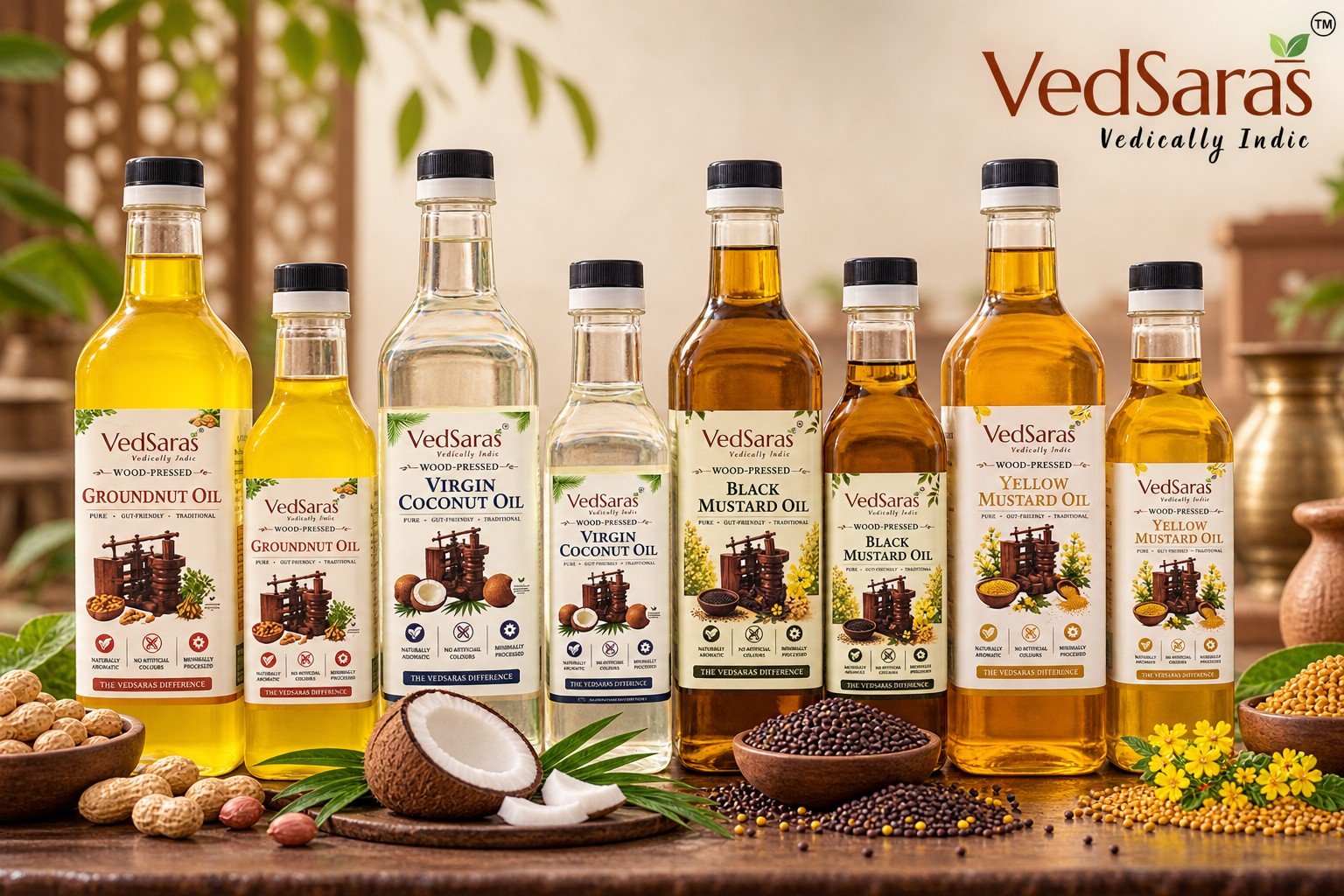
    Many Indian families use one oil for everything, year after year. But different oils bring different fatty-acid profiles, flavours and strengths. Using more than one is a simple, sensible habit.

    Every oil has a different profile

    From our own labels, per the nutrition panel:

    OilSaturatedMUFAPUFA
    Black Mustard8.79 g61.4 g25.7 g
    Yellow Mustard6.5 g68.6 g24.7 g
    Groundnut17.8 g54.2 g27.6 g
    Virgin Coconut91.5 g6.1 g1.4 g

    No single oil has a “perfect” profile. Using a mix across the week naturally balances things out — an approach long encouraged in Indian nutrition guidance.

    A simple rotation plan

    • Mustard oil for high-heat tadka, pickles and frying.
    • Groundnut oil for everyday sabzis and snacks.
    • Virgin coconut oil occasionally, for South Indian dishes and sweets.

    Variety in flavour too

    Rotation is not just about nutrition. A Bengali fish curry in mustard oil, a Gujarati thepla in groundnut oil and a Kerala avial in coconut oil each taste the way they are meant to.

    Remember: moderation first

    Variety works best alongside moderation. Measure, don’t pour, and keep total fat within sensible limits.

    This article is for general information only and is not medical advice. VedSaras products are food items and are not intended to diagnose, treat, cure or prevent any disease. For personal dietary advice, please consult a qualified doctor or nutritionist.
  • Virgin Coconut Oil: What “Virgin” Means and How to Use It

    Virgin Coconut Oil: What “Virgin” Means and How to Use It

    Coconut is so central to Indian life that the coconut palm is called Kalpavriksha — the tree that gives everything. Its oil is just as versatile.

    What does “virgin” mean?

    Virgin coconut oil is obtained from coconut by mechanical means, without refining, bleaching or deodorising. That is why it keeps a light, natural coconut aroma, unlike neutral-smelling refined coconut oil.

    Why does it turn solid?

    Coconut oil is naturally high in saturated fat, which makes it solidify below about 24 °C. In a North Indian winter you will often find it white and solid. That is completely normal — warm the bottle gently and it liquefies again.

    A note on moderation

    Coconut oil is high in saturated fat (about 91.5 g per 100 g, as printed on our label). India’s 2024 dietary guidelines advise limiting saturated fats, so enjoy coconut oil as part of a varied diet rather than as your only cooking fat.

    How to use it

    • South Indian dishes: avial, thoran, olan, coconut-based curries and tadkas.
    • Sautéing: a gentle coconut note for vegetables and seafood.
    • Sweets: ladoos, halwa and baking.
    • Keep heat moderate — virgin coconut oil’s smoke point is commonly cited around 177 °C.

    Did you know?

    The coconut is not truly a nut — botanically it is a drupe. And a coconut palm has no branches at all.

    Try VedSaras Wood Press Virgin Coconut Oil.

    This article is for general information only and is not medical advice. VedSaras products are food items and are not intended to diagnose, treat, cure or prevent any disease. For personal dietary advice, please consult a qualified doctor or nutritionist.
  • Groundnut Oil in Indian Cooking: Flavour, Frying and Tradition

    Groundnut Oil in Indian Cooking: Flavour, Frying and Tradition

    If mustard oil is the bold voice of North and East India, groundnut oil is the gentle, dependable one of the West and South. Mild, nutty and versatile, it lets spices shine without competing with them.

    A crop with a long journey

    Groundnut originated in South America and has been cultivated for roughly 3,500 years. It reached India centuries ago and today India is one of the world’s major groundnut growers, with Gujarat, Andhra Pradesh, Tamil Nadu, Karnataka and Rajasthan among the key producing states.

    Fun fact: it isn’t a nut

    Botanically, the groundnut is a legume — closer to peas and beans than to almonds or walnuts. (It is still a major allergen, so anyone with a peanut allergy should avoid groundnut oil.)

    What it brings to the kitchen

    • A mild, nutty aroma that suits both savoury and sweet dishes.
    • A traditional choice for frying farsan and snacks like pakoras, vadas, chakli and sev.
    • A clean base for poha, upma, thepla, sambhar tadka and chutneys.

    Wood-pressed groundnut oil and heat

    Unrefined groundnut oil has a lower smoke point than refined versions (commonly cited at around 160 °C versus about 232 °C). For deep frying, heat it steadily on medium and avoid letting it smoke. For everyday sautéing and tadka, it is a natural fit.

    From our label

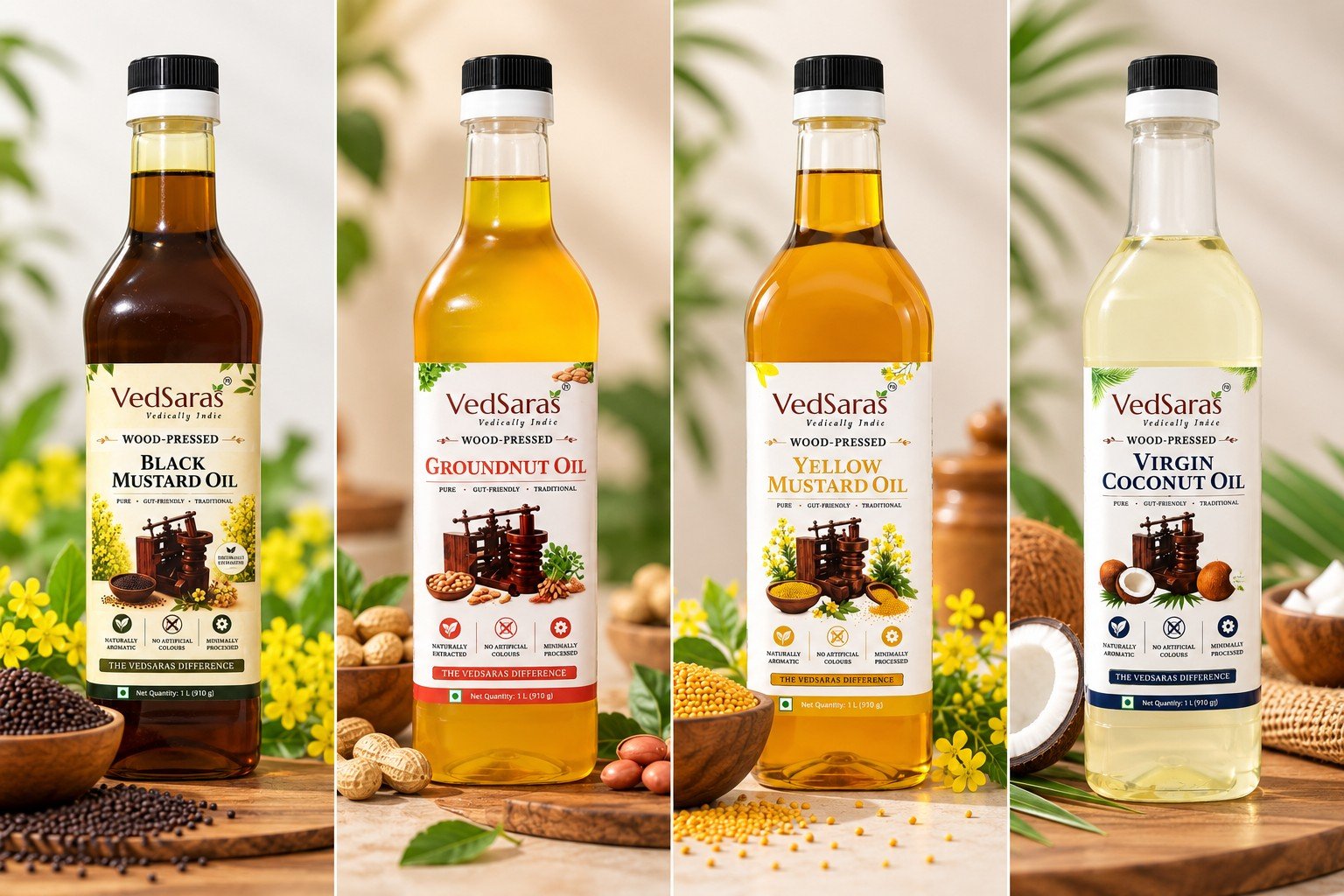
    VedSaras Wood Press Groundnut Oil is made from 100% groundnut, with no preservatives. Discover it here.

    This article is for general information only and is not medical advice. VedSaras products are food items and are not intended to diagnose, treat, cure or prevent any disease. For personal dietary advice, please consult a qualified doctor or nutritionist.

  • What Is Wood-Pressed Oil? Understanding the Traditional Process

    What Is Wood-Pressed Oil? Understanding the Traditional Process

    Walk into an older Indian market town and you may still hear it: the slow creak of a wooden press turning in a circle, crushing mustard seed into oil. This is the ghani — and it is where the VedSaras story begins.

    How a wooden press works

    A wood press is a large mortar with a heavy wooden pestle inside. Seeds — or dried coconut, in the case of coconut oil — are fed into the mortar, and the pestle turns slowly, grinding and pressing them. The oil that separates is collected, left to settle and then filtered before it is bottled.

    How is it different from an expeller?

    Most commercial oil is produced in high-speed metal expellers, often followed by refining. A wood press turns far more slowly. The method is gentler and is one of the oldest ways of extracting oil in India; the oil typically keeps the colour, aroma and flavour of the seed it came from.

    Wood-pressed, cold-pressed, organic — are they the same?

    No. Wood-pressed describes the equipment and method. Cold-pressed refers to pressing without external heat. Organic is a certification about how the seeds were grown. A product can be one without being the others, so it is worth reading labels carefully.

    Choosing a wood-pressed oil

    Each oil brings its own character to the kitchen — the bold pungency of black mustard, the familiar warmth of yellow mustard, the mild nuttiness of groundnut and the light aroma of virgin coconut. Explore the VedSaras collection to find the one that suits your cooking.

  • How to Store Cooking Oils So They Stay Fresh

    How to Store Cooking Oils So They Stay Fresh

    Natural, unrefined oils are full of character — and that character deserves a little care. Store them well and they will taste fresh to the last drop.

    The three enemies: light, heat and air

    • Light speeds up oxidation. Keep bottles in a cupboard, not on a sunny windowsill.
    • Heat does the same. Don’t store oil right next to the gas stove or above the oven.
    • Air slowly stales oil. Close the cap tightly after every use.

    Practical storage tips

    • Decant a small amount into a kitchen dispenser for daily use and keep the main bottle closed in the cupboard.
    • Use a clean, dry spoon or ladle — never put a wet spoon into the bottle.
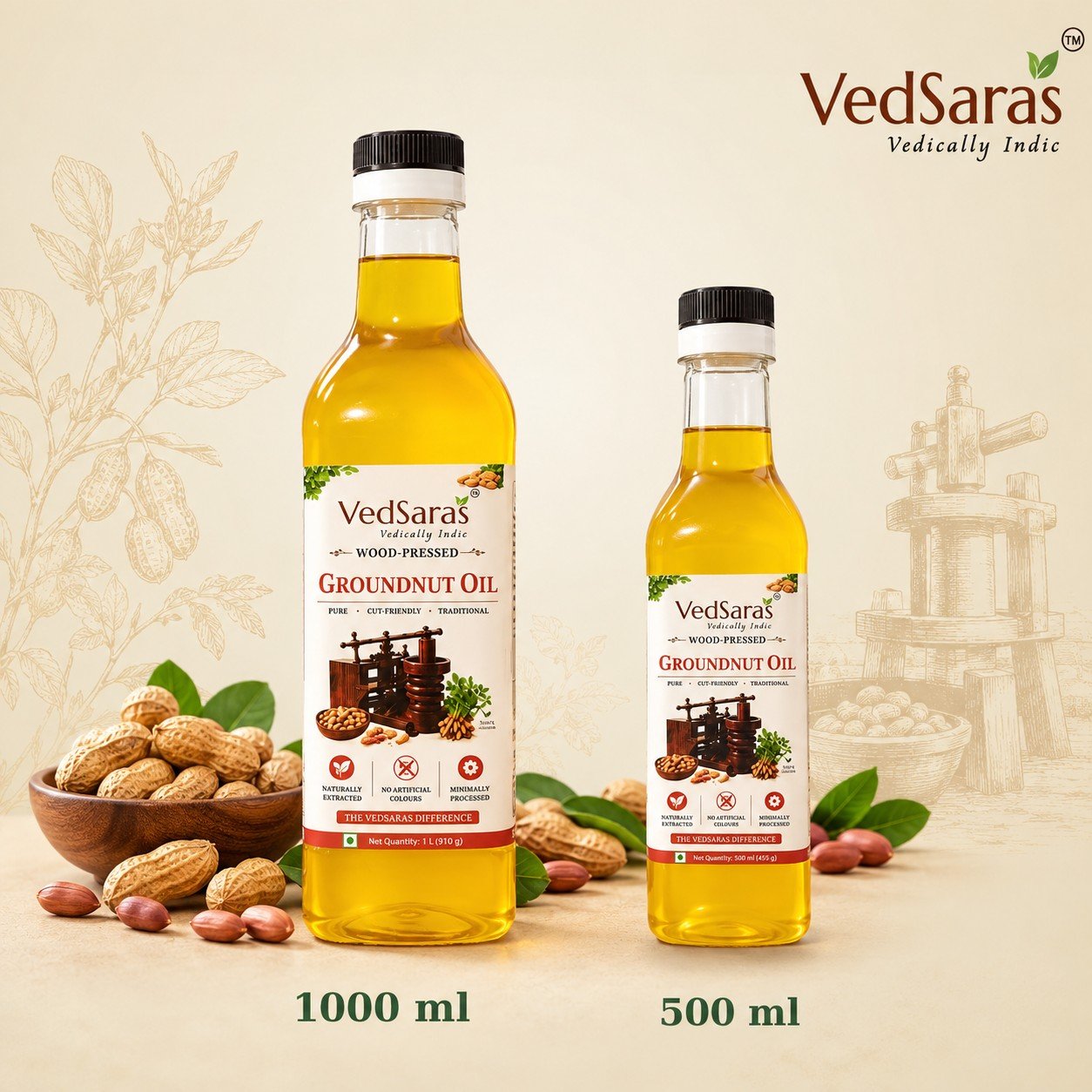
    • Buy a size you will finish comfortably; our 500 ml bottle is perfect for smaller households.
    • Note the best-before date. VedSaras oils are best used within 12 months of packaging.

    Is sediment normal?

    Yes. Wood-pressed oils are not refined, so a little natural sediment may settle at the bottom. Simply avoid pouring out the last bit if you prefer a clear oil.

    Why has my coconut oil gone solid?

    Coconut oil naturally solidifies below about 24 °C. That is not spoilage. Stand the bottle in warm water for a few minutes and it will turn liquid again.

    How do I know oil has gone bad?

    A sharp, crayon-like or “stale” smell, a bitter taste or unusual stickiness are signs of rancidity. When in doubt, throw it out.

    This article is for general information only and is not medical advice. VedSaras products are food items and are not intended to diagnose, treat, cure or prevent any disease. For personal dietary advice, please consult a qualified doctor or nutritionist.

  • Black Mustard Oil vs Yellow Mustard Oil: Which Should You Choose?

    Black Mustard Oil vs Yellow Mustard Oil: Which Should You Choose?

    Both are mustard oils, both are wood-pressed, and both belong in an Indian kitchen. So what is the difference between VedSaras Black Mustard Oil and Yellow Mustard Oil?

    Different seeds

    They are pressed from different mustard seed varieties. Black (brown-black) mustard seed is small and dark; yellow mustard seed is pale and golden. The seed decides the oil’s colour, aroma and strength.

    Colour and aroma

    • Black mustard oil: deep amber, sharply pungent, with the strong “jhaanj” that makes your eyes water a little when the bottle opens.
    • Yellow mustard oil: bright golden, with a familiar mustard note that is comparatively milder and rounder.

    What the labels tell us

    Per labelBlack MustardYellow Mustard
    Energy884.3 kcal892.5 kcal
    Saturated fat8.79 g6.5 g
    MUFA61.4 g68.6 g
    PUFA25.7 g24.7 g

    Both are rich in monounsaturated fats, and both are declared free from argemone seeds with no preservatives.

    Which one for which dish?

    • Choose black for achaar, Bengali fish curries, sarson ka saag and any dish where you want that unmistakable bite.
    • Choose yellow for everyday dals, sabzis, parathas and stir-fries when you want mustard flavour without it taking over.

    Many families keep both. Try Black Mustard Oil and Yellow Mustard Oil side by side and see which your kitchen prefers.

    This article is for general information only and is not medical advice. VedSaras products are food items and are not intended to diagnose, treat, cure or prevent any disease. For personal dietary advice, please consult a qualified doctor or nutritionist.

  • Building a Healthier Lifestyle, One Kitchen Habit at a Time

    Building a Healthier Lifestyle, One Kitchen Habit at a Time

    We often imagine a healthier lifestyle as a big transformation — a new diet, a gym membership, a strict routine. In reality, most lasting change comes from small habits repeated every single day. And for most Indian families, the kitchen is where those habits are built.

    1. Cook at home more often

    Home-cooked food gives you control over ingredients, salt, sugar and the amount of oil. Even swapping two takeaway meals a week for simple home cooking makes a difference over a year.

    2. Use oil thoughtfully, not fearfully

    Fat is an essential part of a balanced diet — the point is moderation. India’s national dietary guidelines (ICMR-NIN, 2024) advise using oils and fats in moderation and keeping total fat within recommended limits. Measure with a spoon instead of pouring straight from the bottle; you will be surprised how much less you need.

    3. Choose ingredients you understand

    Read labels. Prefer foods with short ingredient lists that you can recognise. A single-ingredient oil — just mustard seed, just groundnut, just coconut — is easy to understand.

    4. Bring back seasonal, local eating

    Seasonal vegetables, whole grains, dals and millets are the backbone of traditional Indian meals. They are affordable, flavourful and naturally varied.

    5. Don’t forget the rest of the day

    • Walk after meals, even for ten minutes.
    • Drink enough water.
    • Sleep well — tired bodies crave quick, heavy food.
    • Eat together as a family, slowly, without screens.

    Small steps, big direction

    A healthier lifestyle is not about perfection. It is about direction. Every thoughtful choice — a measured spoon of oil, a home-cooked dinner, a walk in the evening — points you the right way.

    This article is for general information only and is not medical advice. VedSaras products are food items and are not intended to diagnose, treat, cure or prevent any disease. For personal dietary advice, please consult a qualified doctor or nutritionist.

  • Wood-Pressed vs Refined Oils: What Is Actually Different?

    Wood-Pressed vs Refined Oils: What Is Actually Different?

    Walk down any supermarket aisle and you will see “refined”, “cold-pressed”, “kachi ghani” and “wood-pressed” on oil bottles. They are not marketing synonyms — they describe genuinely different ways of making oil.

    How refined oil is made

    Most mass-market oils are extracted with high-speed expellers and often solvents, then refined. Refining typically includes degumming, neutralising, bleaching and deodorising. The result is a clear, neutral-tasting oil with a long shelf life and a high smoke point — but also one that has lost much of the natural colour, aroma and character of the seed.

    How wood-pressed oil is made

    In a wood press, or ghani, seeds are crushed in a large wooden mortar by a slowly rotating wooden pestle. The oil that separates is allowed to settle and is then filtered and bottled. There is no chemical solvent and no refining step.

    What changes in the bottle

    • Aroma and flavour: wood-pressed oils smell and taste of their seed — pungent mustard, nutty groundnut, fresh coconut.
    • Colour: they keep their natural colour, from deep amber to pale gold.
    • Sediment: a little natural sediment can settle at the bottom. That is normal for an unrefined oil.
    • Smoke point: unrefined oils usually have a lower smoke point than their refined versions, so cook with sensible heat.

    Cold-pressed, wood-pressed, organic — are they the same?

    No. Wood-pressed describes the equipment. Cold-pressed describes pressing without external heat. Organic is a certification about how the crop was grown. One does not automatically mean the others, so read labels carefully.

    Why we chose the wooden ghani

    At VedSaras we wanted oils that taste the way our grandparents’ kitchens smelled. Wood pressing is slower and yields less oil per kilo of seed, but it keeps the character of the seed intact — which is exactly the point.

    Explore the VedSaras collection.

    This article is for general information only and is not medical advice. VedSaras products are food items and are not intended to diagnose, treat, cure or prevent any disease. For personal dietary advice, please consult a qualified doctor or nutritionist.

  • Smoke Point Explained: Why Mustard Oil Suits High-Heat Indian Cooking

    Smoke Point Explained: Why Mustard Oil Suits High-Heat Indian Cooking

    Every Indian kitchen knows the moment: the oil in the kadhai starts to shimmer, a thin wisp rises, and the mustard seeds go in with a crackle. That moment is all about temperature — and it is why the idea of a smoke point matters more than most of us realise.

    What is a smoke point?

    The smoke point is the temperature at which an oil begins to give off continuous, visible smoke. Beyond this point the oil starts breaking down: flavour turns acrid, and compounds such as acrolein (the main source of that sharp smoke) begin to form. Cooking consistently past an oil’s smoke point is something every cook should avoid.

    Where does mustard oil stand?

    Mustard oil is one of the more heat-tolerant traditional oils. Reference sources commonly list its smoke point at around 250 °C, compared with roughly 160 °C for unrefined groundnut oil and about 177 °C for virgin coconut oil. Exact figures vary with the seed, the pressing and the freshness of the oil, so treat them as a guide rather than a rule.

    Oil (unrefined unless stated)Commonly cited smoke point
    Mustard oil~250 °C
    Virgin coconut oil~177 °C
    Unrefined groundnut oil~160 °C
    Refined groundnut oil~232 °C

    Why this matters in an Indian kitchen

    Indian cooking leans on high heat: tempering whole spices, bhuno-style frying of masalas, shallow-frying fish and deep-frying pakoras. An oil that tolerates heat gives you more room to work before it smokes. That is one reason mustard oil has been the traditional choice across Bengal, Bihar, Odisha, Punjab, Uttar Pradesh and Kashmir.

    The traditional “smoke and cool” step

    Many households heat mustard oil until it just begins to smoke, then lower the flame for a few seconds before adding spices. This mellows the sharp, nose-tingling pungency and is a time-honoured habit worth keeping — just don’t let the oil keep smoking.

    Smoke point isn’t the whole story

    Food scientists point out that smoke point alone is an imperfect measure. How stable an oil is against oxidation — which depends on its fatty-acid make-up — also matters. Mustard oil is rich in monounsaturated fats (about 61 g per 100 g, as printed on our Black Mustard Oil label), which tend to be more stable under heat than highly polyunsaturated oils.

    Practical tips

    • Heat on medium-high, not maximum. Wait for a shimmer, not a cloud of smoke.
    • Don’t reuse frying oil again and again; discard oil that is dark, thick or foamy.
    • Match the oil to the job: mustard for high-heat tadka and frying, coconut and groundnut for gentler sautéing.

    Explore the VedSaras collection to find the wood-pressed oil that fits your cooking.

    This article is for general information only and is not medical advice. VedSaras products are food items and are not intended to diagnose, treat, cure or prevent any disease. For personal dietary advice, please consult a qualified doctor or nutritionist.