
General

Guides, oil know-how and stories from the VedSaras kitchen.

  • Wood-Pressed vs Refined Oils: What Is Actually Different?

    Wood-Pressed vs Refined Oils: What Is Actually Different?

    Walk down any supermarket aisle and you will see “refined”, “cold-pressed”, “kachi ghani” and “wood-pressed” on oil bottles. They are not marketing synonyms — they describe genuinely different ways of making oil.

    How refined oil is made

    Most mass-market oils are extracted with high-speed expellers and often solvents, then refined. Refining typically includes degumming, neutralising, bleaching and deodorising. The result is a clear, neutral-tasting oil with a long shelf life and a high smoke point — but also one that has lost much of the natural colour, aroma and character of the seed.

    How wood-pressed oil is made

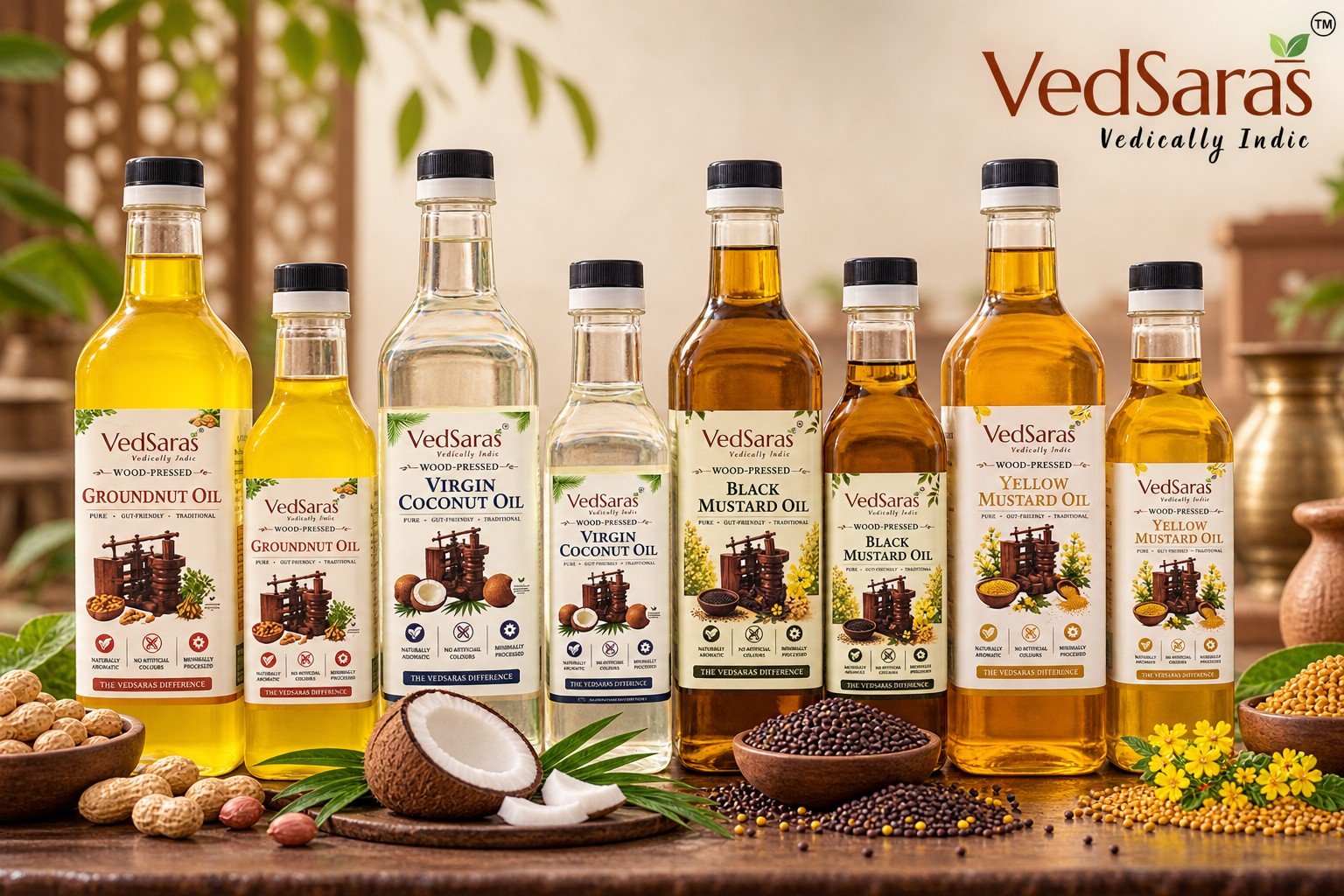
    In a wood press, or ghani, seeds are crushed in a large wooden mortar by a slowly rotating wooden pestle. The oil that separates is allowed to settle and is then filtered and bottled. There is no chemical solvent and no refining step.

    What changes in the bottle

    • Aroma and flavour: wood-pressed oils smell and taste of their seed — pungent mustard, nutty groundnut, fresh coconut.
    • Colour: they keep their natural colour, from deep amber to pale gold.
    • Sediment: a little natural sediment can settle at the bottom. That is normal for an unrefined oil.
    • Smoke point: unrefined oils usually have a lower smoke point than their refined versions, so cook with sensible heat.

    Cold-pressed, wood-pressed, organic — are they the same?

    No. Wood-pressed describes the equipment. Cold-pressed describes pressing without external heat. Organic is a certification about how the crop was grown. One does not automatically mean the others, so read labels carefully.

    Why we chose the wooden ghani

    At VedSaras we wanted oils that taste the way our grandparents’ kitchens smelled. Wood pressing is slower and yields less oil per kilo of seed, but it keeps the character of the seed intact — which is exactly the point.

    Explore the VedSaras collection.

    This article is for general information only and is not medical advice. VedSaras products are food items and are not intended to diagnose, treat, cure or prevent any disease. For personal dietary advice, please consult a qualified doctor or nutritionist.

  • Smoke Point Explained: Why Mustard Oil Suits High-Heat Indian Cooking

    Smoke Point Explained: Why Mustard Oil Suits High-Heat Indian Cooking

    Every Indian kitchen knows the moment: the oil in the kadhai starts to shimmer, a thin wisp rises, and the mustard seeds go in with a crackle. That moment is all about temperature — and it is why the idea of a smoke point matters more than most of us realise.

    What is a smoke point?

    The smoke point is the temperature at which an oil begins to give off continuous, visible smoke. Beyond this point the oil starts breaking down: flavour turns acrid, and compounds such as acrolein (the main source of that sharp smoke) begin to form. Cooking consistently past an oil’s smoke point is something every cook should avoid.

    Where does mustard oil stand?

    Mustard oil is one of the more heat-tolerant traditional oils. Reference sources commonly list its smoke point at around 250 °C, compared with roughly 160 °C for unrefined groundnut oil and about 177 °C for virgin coconut oil. Exact figures vary with the seed, the pressing and the freshness of the oil, so treat them as a guide rather than a rule.

    Oil (unrefined unless stated)Commonly cited smoke point
    Mustard oil~250 °C
    Virgin coconut oil~177 °C
    Unrefined groundnut oil~160 °C
    Refined groundnut oil~232 °C

    Why this matters in an Indian kitchen

    Indian cooking leans on high heat: tempering whole spices, bhuno-style frying of masalas, shallow-frying fish and deep-frying pakoras. An oil that tolerates heat gives you more room to work before it smokes. That is one reason mustard oil has been the traditional choice across Bengal, Bihar, Odisha, Punjab, Uttar Pradesh and Kashmir.

    The traditional “smoke and cool” step

    Many households heat mustard oil until it just begins to smoke, then lower the flame for a few seconds before adding spices. This mellows the sharp, nose-tingling pungency and is a time-honoured habit worth keeping — just don’t let the oil keep smoking.

    Smoke point isn’t the whole story

    Food scientists point out that smoke point alone is an imperfect measure. How stable an oil is against oxidation — which depends on its fatty-acid make-up — also matters. Mustard oil is rich in monounsaturated fats (about 61 g per 100 g, as printed on our Black Mustard Oil label), which tend to be more stable under heat than highly polyunsaturated oils.

    Practical tips

    • Heat on medium-high, not maximum. Wait for a shimmer, not a cloud of smoke.
    • Don’t reuse frying oil again and again; discard oil that is dark, thick or foamy.
    • Match the oil to the job: mustard for high-heat tadka and frying, coconut and groundnut for gentler sautéing.

    Explore the VedSaras collection to find the wood-pressed oil that fits your cooking.

    This article is for general information only and is not medical advice. VedSaras products are food items and are not intended to diagnose, treat, cure or prevent any disease. For personal dietary advice, please consult a qualified doctor or nutritionist.